

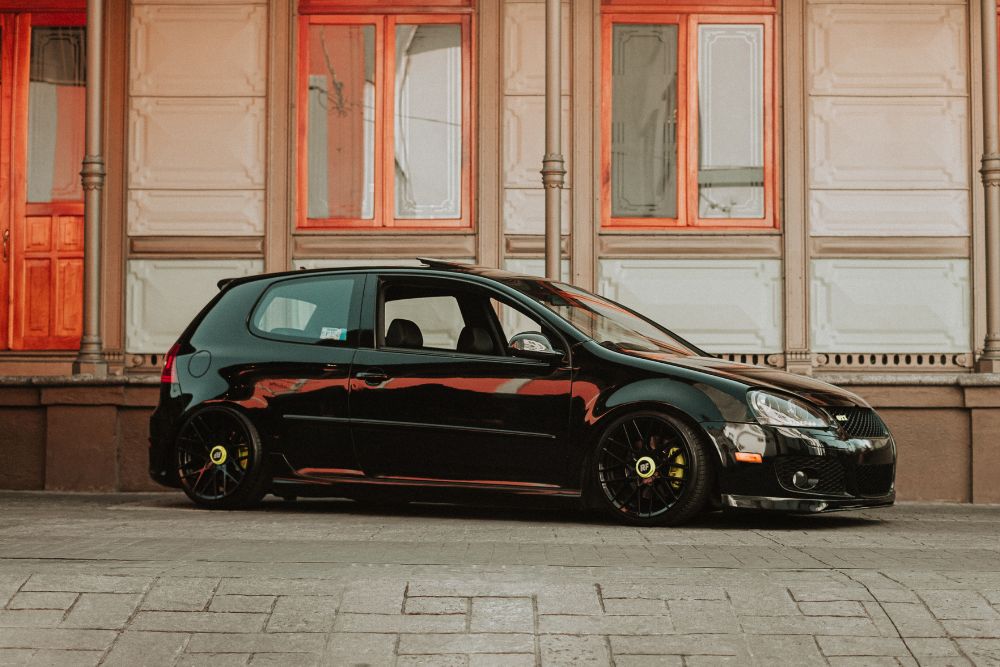
The five Golf GTI DSG gearbox problems owners report most often are juddering when pulling away, harsh or delayed gear changes, limp mode with a flashing gear indicator, clutch slip under hard acceleration, and overheating.
Transmission fluid condition, clutch wear and mechatronic faults sit behind many of them, though sensors, wiring, fluid level, the dual-mass flywheel and cooling faults can produce the same symptoms.
On-time servicing removes a large share of the avoidable risk, but it cannot prevent every electrical or mechanical failure.
What makes these faults awkward is that several of them feel almost identical from the driver’s seat.
Getting the diagnosis wrong can turn a straightforward fluid and filter job into a gearbox rebuild, so knowing which symptom points to which cause is what separates a cheap fix from an expensive one.
What Are the 5 Most Common Golf GTI DSG Gearbox Problems?
The five faults that come up most often in Golf GTI owner reports are low speed judder, harsh or delayed shifts, limp mode, clutch slip, and overheating.
Each one has several possible causes and a different diagnostic path, even though several of them produce similar sensations through the pedals and the seat.
The table below sets out what each fault feels like, what commonly causes it, and where a workshop normally starts looking.
| Problem | What you feel | Common causes | Where diagnosis starts |
| Low speed judder | Shuddering or vibration as the car pulls away from a stop | Clutch wear, fluid condition or level, adaptation values, dual-mass flywheel, engine or mount faults | Fault codes and live clutch data, fluid condition and level check |
| Harsh or delayed shifts | Clunking, jerking, or a long pause before the gear engages | Fluid condition, blocked filter, hydraulic pressure loss, clutch wear, software or sensor faults | Fault codes, live pressure and solenoid data |
| Limp mode | Flashing gear indicator, loss of drive, gearbox held in limited gears | Sensor, solenoid or wiring faults, hydraulic pressure loss, overheating, voltage supply, mechanical damage | Full fault code read before any parts are fitted |
| Clutch slip | Engine revs climb but the car does not accelerate with them | Worn friction plates, insufficient clutch clamping pressure, hydraulic control faults, torque above calibration | Live clutch slip and pressure data under load |
| Overheating | Reduced power, or a gearbox temperature warning | Fluid condition or level, cooling circuit faults, repeated clutch slip, sustained high load | Oil temperature logging and cooling circuit check |
The pattern worth noticing is that no symptom in that table maps to a single cause.
Transmission fluid and filter condition appear as a possible factor in every one of them, which is why an overdue service is a reasonable first thing to rule out.
That is not the same as saying a service will fix the fault, and the only way to know is to read the gearbox data before committing to any repair.
Why Does Your Golf GTI Judder When Pulling Away?
Judder or shudder as a GTI pulls away from a standstill can result from clutch wear, transmission fluid that has lost its friction properties, an incorrect fluid level, or adaptation values that no longer match the clutch.
The clutches in a GTI DSG are wet clutches.
Volkswagen’s technical documentation for the 02E gearbox states that “in place of a dry clutch, two wet clutches are used” and that these wet clutches rotate in transmission fluid.
That fluid carries the friction modifiers that let the clutch grip smoothly as it takes up drive, and those additives degrade over time.
When they do, the clutch can grab and release in rapid succession instead of engaging progressively, and you feel that as a shudder through the floor at walking pace.
A dual-mass flywheel, engine misfire, or worn mounts can produce a similar sensation, which is why judder on its own does not confirm a gearbox fault.
Where fluid condition or level turns out to be the cause, correcting it can resolve the judder, but resetting adaptation values will not restore friction material that has already worn away.
What Is Clutch Adaptation and When Is It Actually Needed?
Clutch adaptation is a control module procedure that relearns where each clutch begins to take up drive, and it is carried out after specific repairs or when diagnostic data calls for it, not automatically after every oil change.
Ross-Tech’s procedure for the six-speed DSG sets out the basic settings sequence and lists a fluid temperature of 30 to 100 degrees Celsius as a prerequisite for running it, along with a defined test drive afterwards.
That temperature window applies when the basic settings procedure is being performed, such as after a mechatronic unit is replaced.
It is not a statement that every routine fluid change requires the procedure to be run.
Whether adaptation is worth doing on a given car depends on the gearbox, the work carried out, and what the live clutch data shows.
On a car that already judders, running the procedure can be a useful diagnostic step, because a clutch that will not adapt into range points towards mechanical wear rather than a software issue.
Treating adaptation as an automatic add-on to every service is unnecessary, and treating it as never relevant misses the cases where it genuinely matters.
Why Does a Golf GTI DSG Shift Harshly or Hesitate Between Gears?
Harsh, clunky, or delayed gear changes in a Golf GTI can point to contaminated fluid, a blocked filter, falling hydraulic pressure, clutch wear, or a sensor and software fault.
The mechatronic unit is the hydraulic and electronic control assembly that operates the clutches and selects the gears.
It depends on clean fluid delivered at a precise pressure, and Volkswagen’s 02E documentation describes a crescent shaped pump producing up to 100 litres per minute and a maximum pressure of 20 bar for the hydraulic components.
When a filter restricts flow or fluid condition deteriorates, the unit can struggle to deliver pressure at the right moment, so shifts arrive late and land hard.
Delayed engagement when you select drive or reverse is a related symptom, and it often shows up first thing in the morning before the fluid warms.
A harsh shift does not by itself prove the filter is blocked, and the same complaint can come from worn clutches or a control fault.
Reading fault codes alongside live pressure and solenoid data is what separates those causes, and it should happen before any parts are ordered.
What Causes a Golf GTI DSG to Drop Into Limp Mode?
Limp mode is triggered when the control module detects a fault it cannot work around, and the causes include sensor, solenoid and wiring faults, hydraulic pressure loss, overheating, low system voltage, and mechanical damage.
Depending on the fault, the gearbox may open the clutches entirely or hold a limited number of gears so the car can still be moved.
The classic warning is a flashing gear position indicator in the instrument cluster, sometimes with the car behaving as though it has selected neutral.
Volkswagen documented one version of this in a safety recall covering certain 2009 and 2010 GTI, Jetta and Eos models fitted with DSG.
The recall notice states that insufficiently crimped connector wires in the gearbox temperature sensor harness could make the sensor falsely detect a high gearbox oil temperature, causing the clutch to open, with a flashing selector lever position indicator as the driver’s first warning.
That case is a useful lesson for any GTI owner, because it shows the gearbox can lose drive over a sensor reading rather than genuine mechanical damage.
Reading the stored fault codes with equipment that can access Volkswagen gearbox data is what distinguishes a failed sensor from a failed mechatronic unit, and the difference between those two repairs is substantial.
Why Does a Golf GTI DSG Slip or Flare Under Hard Acceleration?
Slipping under load means the clutch is no longer holding the torque the engine is producing, so the revs rise without matching acceleration.
Worn friction plates are one cause, and insufficient clamping pressure from a hydraulic or control fault is another, so slip alone does not confirm the clutch packs are finished.
You typically notice it first in the higher gears under full throttle, because that is where torque loading on the clutch peaks, although this pattern is not diagnostic on its own.
Torque capacity is part of the picture on modified cars.
Volkswagen’s 02E documentation gives the gearbox a maximum input torque of 350 Nm, or 258 lb-ft, described as engine dependent, while later published figures for the DQ250 with factory mechatronic programming are commonly quoted at around 295 lb-ft.
Those figures vary by version and calibration, so no single number should be treated as a universal hardware limit, but both sit within reach of a stage one 2.0 TSI tune.
Once the clutch is asked to hold more torque than its clamping force allows, it slips, and every slip generates heat that degrades both the friction material and the fluid around it.
Slip does not repair itself, so continuing to drive on it risks contaminating the fluid with clutch material and spreading the problem further into the gearbox.
What Makes a Golf GTI DSG Gearbox Overheat?
A GTI DSG overheats when heat generated at the clutches exceeds what the transmission fluid and the cooling circuit can carry away.
The cooling is not a matter of airflow over the gearbox casing.
Volkswagen’s 02E documentation states that “a separate transmission fluid cooler prevents the transmission fluid temperature from rising above 135°C” and that this cooler uses engine coolant to reduce temperature.
That means fluid level and condition, the cooler itself, and the engine cooling system all sit in the path between the clutches and the heat leaving the car.
The same document sets out what happens when that path cannot keep up.
At 138 degrees Celsius the mechatronics initiates a reduction in engine torque, and above 145 degrees Celsius the multi-plate clutches are no longer supplied with fluid pressure and the clutches open.
Owners experience the first stage as sudden power loss and the second as a complete loss of drive.
Repeated low speed clutch slip in stop start traffic, track use, launch control and towing all raise clutch temperatures, though they load the gearbox in different ways and over different timeframes.
Where fluid or filter condition is the limiting factor, servicing helps, but it will not correct a failed cooler, a hydraulic fault, or clutches that are slipping because they are worn.
Cars used regularly on track are worth monitoring for oil temperature first, and an additional gearbox oil cooler is a modification to consider on the evidence of those readings rather than a default repair.
Which DSG Gearbox Does Your Golf GTI Have?
Golf GTIs use two different wet clutch DSG gearboxes depending on generation: the six-speed DQ250 in earlier cars and the seven-speed DQ381 in later ones.
The DQ250 was fitted to Mk5 and Mk6 GTIs and continued into the Mk7, and the DQ381 replaced it on later Mk7.5 and Mk8 cars.
The exact changeover point varies by market and model year, so the gearbox should be confirmed from the vehicle data or transmission code rather than assumed from the badge.
Both are wet clutch designs, which is why GTIs avoid the dry clutch reliability issues that affected some lower powered Volkswagen models.
Knowing which unit you have matters more than most owners realise, because the service interval, the fluid specification, the fluid quantity, the filter and the procedure all differ between the two.
This is worth checking carefully in New Zealand, where the GTI market includes a mix of new vehicles and used Japanese imports across several model years.
A workshop that services these gearboxes regularly will identify the unit from the vehicle data before quoting, rather than assuming from the model year alone.
How Often Should a Golf GTI DSG Gearbox Be Serviced?
The service interval depends on which gearbox your GTI has, and the two units are not on the same schedule.
Volkswagen’s published maintenance schedules list the six-speed DQ250 for a fluid and filter change every 40,000 miles, which is 60,000 kilometres, while later GTI and Golf R models with the seven-speed unit are listed at every 80,000 miles, or 120,000 kilometres.
The procedure differs as well as the interval.
Volkswagen Group’s trade parts division sets out the scheduled operation as “40,000 miles, fluid and filter” for the DQ250 and “80,000 miles, fluid only” for the DQ381.
Because intervals have also changed across model years, the schedule for your specific vehicle and model year is the figure that applies, not a general rule for all GTIs.
Those intervals assume ordinary use, and plenty of GTIs in New Zealand do not get ordinary use.
Cars driven hard, used on track, launched frequently, or spent mostly in heavy traffic put more heat through the fluid.
For those cars, Dodson Motorsport recommends servicing at the shorter end of the range as a precaution, which is a workshop recommendation rather than a Volkswagen requirement.
The core of a correct DSG service is the same either way, and a proper job includes:
- Scanning for fault codes before work starts, so an existing fault is not mistaken for a service item
- Draining the old fluid and replacing the filter where the gearbox is specified with one
- Refilling with the exact fluid specification and quantity for your gearbox variant
- Setting the fluid level at the correct temperature window, since the level is temperature dependent
- A test drive to confirm the gearbox behaves correctly afterwards
Clutch and gear calibration is carried out where the gearbox and the work done call for it, rather than as an automatic part of every oil change.
Getting the fluid specification or the level wrong is the mistake most likely to leave a car shifting worse than it did before the service.
Can You Keep Driving a Golf GTI With DSG Problems?
Stop driving if the car has lost drive, if a gearbox temperature warning tells you to stop, or if the gear indicator is flashing, and arrange a diagnosis rather than clearing the fault and carrying on.
Limp mode exists to protect the gearbox, and repeatedly restarting the car to clear it leaves the underlying fault unaddressed while the car continues to be driven.
Clutch slip is the symptom least worth putting off, and it sits alongside the other habits that kill an automatic transmission.
Every slipping engagement can shed friction material into the fluid, and that material then circulates through the filter, the cooler, and the mechatronic valve body.
That is one route by which a clutch problem becomes a mechatronic problem.
Judder and mildly harsh shifts are less alarming to drive with, but they still warrant prompt diagnosis, because the same symptoms can come from fluid, clutch, flywheel, hydraulic or control faults.
The value of looking early is that it identifies which of those it is while the cheaper options are still on the table.
The difference in cost between a fluid service and a clutch or mechatronic replacement is large enough that a diagnostic scan is worth doing well before symptoms become severe.
Does a Warrant of Fitness Check Your DSG Gearbox?
No, a Warrant of Fitness does not check the condition of your DSG gearbox, its fluid, or its shift quality.
The NZTA Waka Kotahi inspection requirements for engine and transmission cover mounting security and driveshaft condition, with rejection criteria such as an insecure gearbox mounting or a worn universal joint.
Nothing in those requirements assesses internal gearbox condition, fluid quality, or clutch wear.
Because gearbox health was never part of the inspection, the service schedule is the only routine check your DSG actually gets.
That becomes more relevant as inspections themselves become less frequent.
Under the changes to light vehicle inspections from 1 November 2026, vehicles aged four to fourteen years registered on or after 1 November 2019 move to a Warrant of Fitness every two years from 1 November 2026, and vehicles registered between 1 November 2013 and 31 October 2019 follow from 1 November 2027.
Owners who treated the annual Warrant of Fitness as a general health check will now have their car in front of a workshop less often, which makes tracking the gearbox service interval yourself more important than it was.
Why Do Tuned Golf GTIs Wear DSG Clutches Faster?
A tuned GTI can wear its DSG clutches faster when the extra torque, heat or clutch slip exceeds what the calibration and hardware were set up to handle.
The clutch packs are sized around the factory torque output with a margin built in, and a stage one tune on a 2.0 TSI can consume much of that margin.
Where torque exceeds what the clutch can hold, the plates slip briefly at each hard engagement, and the heat from that slip degrades both the friction material and the fluid.
This is why some tuned cars show judder or slip at mileages where a standard car is still shifting cleanly.
A properly calibrated tune within the gearbox’s capability does not automatically mean accelerated wear, and the outcome depends on how the torque and clutch pressure are managed.
A gearbox software calibration can adjust clutch pressure targets, torque limits and shift behaviour to suit a higher output, though it does not make standard hardware suitable for unlimited torque, and larger power increases may call for upgraded clutch packs.
Shortening the fluid service interval on a tuned car is a straightforward precaution that owners can take alongside matching the gearbox calibration to the engine.
Get Your Golf GTI DSG Gearbox Sorted in Auckland
Golf GTI DSG gearbox problems can come from fluid condition, clutch wear, hydraulic faults or the mechatronic unit, and reading the gearbox data is what tells you which.
Correct diagnosis, the right fluid specification for your gearbox variant, and an accurate fluid level make the difference between a gearbox that lasts and one that does not.
As a specialist DSG servicing workshop in Auckland, Dodson Motorsport can diagnose and repair the full range of Golf GTI DSG faults.
Contact our team today by calling 09 441 3635 or emailing service@dodsonmotorsport.com.
Frequently Asked Questions
How much does it cost to fix a Golf GTI DSG gearbox?
Cost depends entirely on the fault. A fluid and filter service is the least expensive outcome, though it only resolves the problem where fluid condition or level was the cause. Clutch pack replacement costs considerably more, and a mechatronic unit repair or replacement more again. Reading the gearbox data before any work begins is what prevents paying for parts the gearbox did not need.
Can bad DSG fluid cause juddering in a Golf GTI?
Yes, it is one recognised cause. DSG fluid carries friction modifiers that let the wet clutches engage smoothly, and those additives degrade with heat and mileage. Judder can also come from clutch wear, an incorrect fluid level, adaptation values, or a dual-mass flywheel, so the symptom alone does not identify the cause without diagnostic data.
What does a flashing gear indicator mean on a Golf GTI?
A flashing gear position indicator means the transmission control module has detected a fault and moved the gearbox into a protective mode. The car may feel as though it has selected neutral, or it may hold limited gears. Causes include sensor, wiring, hydraulic, overheating and voltage faults. Stop driving and have the stored fault codes read.
How often should DSG fluid be changed in a Golf GTI?
It depends which gearbox you have. Volkswagen lists the six-speed DQ250 for a fluid and filter change every 40,000 miles, or 60,000 kilometres, and later GTIs with the seven-speed DQ381 at every 80,000 miles, or 120,000 kilometres, fluid only. Confirm the interval for your specific model year rather than applying one figure to all GTIs.
Is a DSG gearbox reliable in a Golf GTI?
The wet clutch DSG units fitted to the Golf GTI are durable when serviced to the correct schedule, and they avoid the dry clutch problems that affected some lower powered models. Servicing on time, matching any tune to the gearbox calibration, and diagnosing symptoms early all reduce the risk of an expensive failure later.